Natural laxatives and 7 more home remedies for constipation
Constipation affects about one person in five, and most of it responds to unglamorous things: water, fiber, movement, and going when you need to go.
First, the definition, because it saves a lot of unnecessary worry. MedlinePlus counts constipation as “having fewer than three bowel movements a week”, with stool that may be hard and dry. And it adds the sentence that half the people reading this need: “it’s not important that you have a bowel movement every day.”
Here is what French grandmothers did, from the gentlest upward.
Prunes, and they earned their reputation
Soak 5 or 6 prunes in a glass of water overnight. In the morning, eat the prunes and drink the water, on an empty stomach.
Prunes contain sorbitol, a sugar that is poorly absorbed and pulls water into the bowel, plus soluble fiber. It is the single most recognized natural laxative there is, and it is a food rather than a medicine.
Dried figs
Soak 3 dried figs in ¾ cup (200 ml) of lukewarm water for 30 minutes to an hour. Eat the softened figs and drink the soaking water, in the morning on an empty stomach or at bedtime.
Dried figs carry roughly 10 g of fiber per 3.5 oz (100 g). Soaking is not decoration: it pre-hydrates the fiber, which is exactly what makes fiber work instead of sit there.
Eaten dry, they need a large glass of water alongside. That rule runs through this whole page.
Olive oil on an empty stomach
Every morning, swallow 1 tablespoon (15 ml) of cold-pressed extra virgin olive oil, followed straight away by half a glass of warm water with the juice of half a lemon. Wait 30 minutes before breakfast. The effect comes 2 to 4 hours later.
A Mediterranean solution measured in centuries rather than studies, and it is gentle.
Not with diagnosed gallstones.
Kiwi
Eat 2 well-ripened green kiwis every morning, 30 minutes before breakfast. Ripe means the flesh yields slightly under a thumb.
Green rather than gold: the yellow varieties are lower in fiber.
Psyllium, flaxseed, and the rule that makes them safe
Blond psyllium husk. Start with 1 level teaspoon (3 g) in a large glass of water (1 cup / 250 ml). Stir and drink immediately, before the gel forms. Follow with a second glass of water. Build up to 1 tablespoon (10 g) a day if it suits you.
Flaxseed. One tablespoon of ground seeds, in a large glass of water or stirred into a yogurt, with more water after.
Never take either without drinking enough water. Psyllium forms a gel in the gut, and a gel without fluid can cause a blockage rather than clear one. This is the one genuinely dangerous mistake on this page.
Space them 2 hours from your medicines, both reduce absorption. And avoid psyllium entirely if you have a known intestinal narrowing or obstruction.
NCCIH has no psyllium or flaxseed page, so what you have here is long practice plus a safety rule that is not negotiable.
Magnesium, for the occasional blockage
Dissolve 1 teaspoon (5 g) of magnesium citrate powder in ¾ cup (200 ml) of lukewarm water, following the dose on your own packaging since concentrations differ. Drink it in the evening for an effect on waking, about 6 hours later. Start at half a dose to see how you react, and drink plenty of water.
This is occasional use, not a daily supplement.
Do not take it if you already have abdominal pain, nausea or vomiting. Those can signal an obstruction, and giving a laxative to a blocked bowel is how a bad situation becomes an emergency. If the nausea is the main event, treat that first: our nausea remedies also list the signs that mean calling rather than waiting.
Also out with kidney failure. And space it 2 to 3 hours from antibiotics of the quinolone or tetracycline family, and from bisphosphonates.
Coffee, and it is not a joke
A cup of coffee, about ¾ cup (200 ml), in the morning, ideally 30 minutes after getting up, with a large glass of water alongside. The effect turns up within half an hour in people who respond to it.
It works partly through the gastrocolic reflex, the same one that gets things moving after any meal, and the morning is when the colon is naturally most active. Decaf keeps much of the effect, which tells you caffeine is not the whole story.
Out if you have reflux, an ulcer, uncontrolled high blood pressure or an anxiety disorder, and in pregnancy. If reflux is your problem too, the coffee here and the advice on our heartburn and indigestion page pull in opposite directions, and reflux wins.
The colon self-massage
This one follows the actual anatomy, which is why the direction matters.
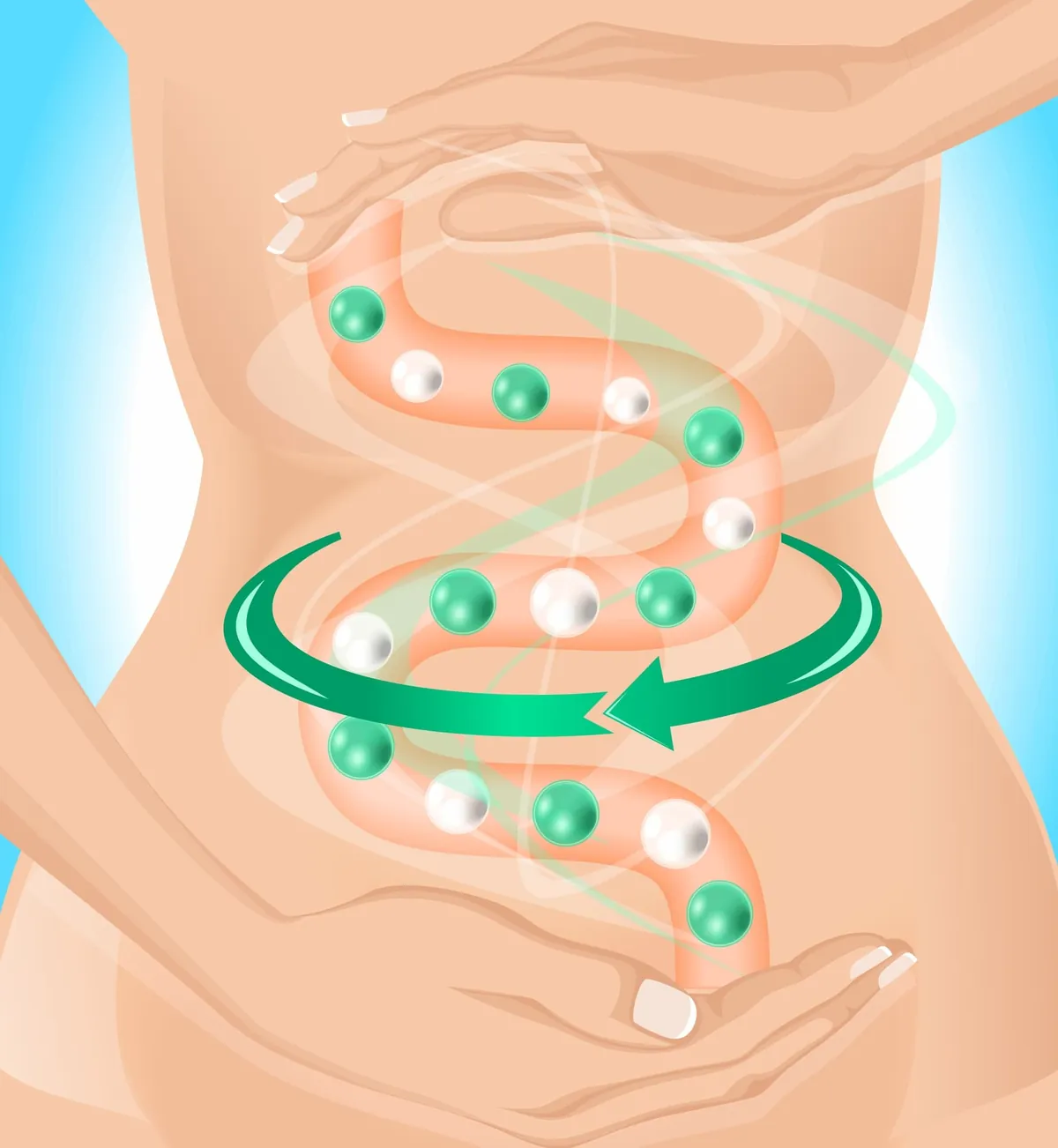
Lie on your back with your knees bent and breathe calmly. Put both hands, one on top of the other, 2 inches (5 cm) to the right of the navel. Make 10 small circles, pressing gradually as though kneading dough. Work up to the right ribs, across to the left under the ribs, then down the left side to the groin.
Start gently and increase until you can feel the intestine under your fingers, never to the point of pain. Five to ten minutes, twice a day: on waking, and 30 minutes after dinner.
Three yoga positions
Five minutes in the morning on an empty stomach, or 2 hours after a meal.
- Seated twist. Sitting with legs out, bend the right knee and place the right foot outside the left knee. Turn the torso right, pushing the knee with the left elbow. One minute each side.
- Child’s pose, modified. Kneeling, knees apart, big toes touching, lean forward with the forehead down and arms out. Rock gently side to side for 2 minutes.
- Knees to chest. On your back, both knees hugged to the chest, rocking gently for a minute. This is the one that releases trapped gas.
Avoid all three in pregnancy, after recent abdominal surgery, or with a hiatal hernia.
Probiotics
One capsule of 10 billion CFU of Lactobacillus rhamnosus and Bifidobacterium lactis, in the morning on an empty stomach with a glass of water, as a 4 to 8 week course. Choose enteric-coated so they reach the intestine, and refrigerate them.
Particularly worth it after a course of antibiotics.
MedlinePlus lists probiotics among the things that help people manage irritable bowel syndrome, which is the neighbouring complaint when constipation alternates with the opposite.
What MedlinePlus puts first, and grandmothers did too
The four measures at the top of its list are the least interesting and the most effective:
- “eating more fruits, vegetables and grains, which are high in fiber”;
- “drinking plenty of water and other liquids”;
- “getting enough exercise”;
- “taking time to have a bowel movement when you need to”.
That last one is the one people override for years. Ignoring the signal because you are busy is how the reflex gets blunted.
On laxatives, MedlinePlus says to use them only with your provider’s approval, and to ask whether any medicine you take might be the cause. That second question is worth asking out loud: a great many common medicines constipate.
When to see a doctor
A change in your usual bowel habits is worth a call, which is MedlinePlus’s own trigger and is deliberately low.
Call sooner for: blood in the stool or on the paper, constipation with abdominal pain and vomiting, unexplained weight loss, stools that have become persistently thin, constipation that is new after the age of 50, or constipation alternating with diarrhea over weeks.
And treat abdominal pain with nausea and vomiting as a reason not to take a laxative at all, but to get seen.
FAQ
How much water is “plenty” with psyllium?
A full glass to mix and drink it, and a second full glass straight after. If that feels like a lot, that is the point: the fiber has to have something to absorb, and the second glass is the safety margin rather than a suggestion.
Do I need to go every day?
No. MedlinePlus says so directly, and the medical definition of constipation starts below three times a week. What matters more than the number is a change from what is normal for you.
Which of these works fastest?
Magnesium, about six hours, which is why it is taken at night. Coffee, within half an hour if you respond to it. Prunes, figs and psyllium work over days rather than hours, and they are the ones you can keep doing.

Virginie Verglas
Virginie is a French journalist and author. She founded Grands-Mères.net in 2012, and her book "The French Book of Natural Remedies" is the American edition of her work on traditional remedies.