Home remedies for heartburn and indigestion
Two complaints, one page, because in practice they arrive together and the remedies overlap almost entirely.
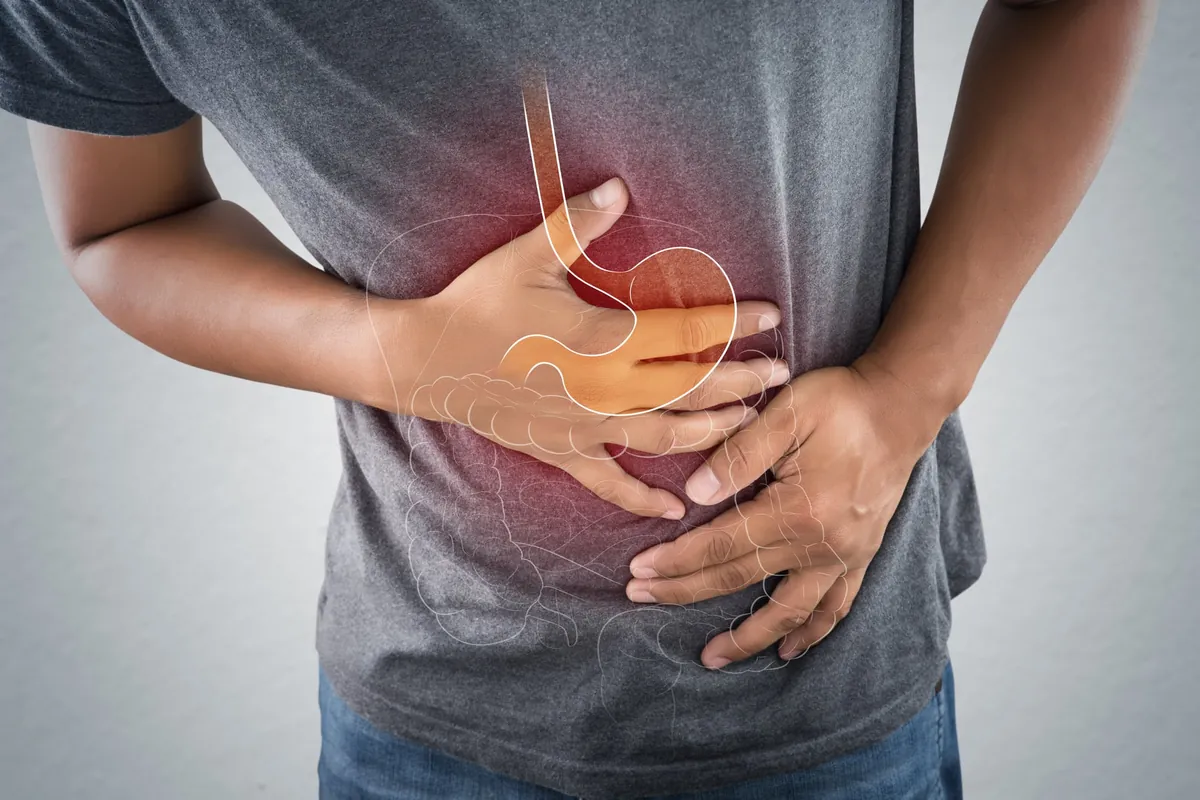
Heartburn is the burning that rises from the stomach toward the throat, and it affects roughly one person in three. Indigestion, which doctors call dyspepsia, is the heaviness an hour after a good meal: bloated, uncomfortable, sometimes painful.
French grandmothers treated the first with soothing and posture, and the second with bitter and aromatic plants. Here is both, and the line at the end that decides when neither applies.
Read this first: what is not heartburn
MedlinePlus is unambiguous, and it belongs at the top rather than the bottom: “Get medical help right away if you have chest pain with shortness of breath, or pain in your jaw or arm. These can be signs of a heart problem.”
Heart attacks are mistaken for indigestion often enough that it is worth knowing the difference exists. If you are unsure, that uncertainty is itself the reason to call.
Raising the head of the bed
The most effective thing on this page costs nothing and takes ten minutes once.
Put blocks under the feet at the head of the bed, 6 to 8 inches (15 to 20 cm) high, so the whole bed slopes. Then sleep on your left side.
Not extra pillows. Stacking pillows bends you at the waist and presses on the stomach, which is the opposite of what you want. The slope has to run the length of the bed.
MedlinePlus lists the same two measures among its self-care advice, alongside “eating smaller meals and avoiding lying down for at least 2-3 hours after eating”, avoiding trigger foods such as spicy food, chocolate, caffeine and fatty food, loose clothing, and quitting smoking. Grandmothers had all of that, minus the vocabulary.
Baking soda, for the flare-up
Dissolve ½ teaspoon of baking soda in a glass of lukewarm water, stir until it has fully dissolved, and drink it slowly. Three times a day at most, at least 2 hours apart, and for no more than 2 consecutive weeks.
It neutralizes part of the stomach acid, which is why relief is quick and why it is not a long-term answer.
Not if you are on a low-sodium diet or have high blood pressure. Baking soda is sodium bicarbonate, and the sodium is the whole molecule.
Space it from your medicines, at least 2 hours: it changes the pH of the stomach and can reduce how well some medicines are absorbed. The same spoonful, at the same dose, is one of our nausea remedies for the queasiness that follows a heavy meal.
The anti-reflux herbal blend
Mix 30 g of lemon balm leaves, 20 g of German chamomile flowers, 20 g of lemon verbena leaves and 10 g of lightly crushed fennel seeds in an airtight jar. It keeps 6 months away from light.
For each cup, pour 1 cup (250 ml) of water at 176 to 185°F (80 to 85°C) over 1 tablespoon of the mix. Cover, steep 10 minutes, strain. One cup after each main meal.
Who this blend is not for: pregnancy and breastfeeding, anyone with a history of hormone-dependent cancer (fennel), and anyone allergic to Asteraceae, the daisy family, which includes ragweed, arnica and dandelion.
That last one is not a formality. NCCIH’s chamomile page carries anaphylaxis, cross-allergy to the daisy family and an interaction with warfarin, and notes that little is known about safety in pregnancy or breastfeeding.
Fennel, on its own, for heavy digestion
Pour 1 cup (250 ml) of just-simmering water at 176°F (80°C) over 1 teaspoon (2 g) of lightly crushed fennel seeds. Cover, steep 10 minutes, strain. One lukewarm cup 20 minutes after each main meal, up to 3 cups a day for no more than 3 weeks.
In a hurry, chew ½ teaspoon of the seeds slowly after the meal.
Fennel is the French digestive plant, and it carries real limits: not during pregnancy or breastfeeding, not under 12, and not with a hormone-dependent condition of the breast, uterus or ovary, because the seeds contain phytoestrogens. It can also interact with some anticoagulants.
NCCIH has no fennel page, so this is a kitchen tradition offered as one.
The other digestive plants, and what each is for
French grandmothers had a small shelf of these, and they were not interchangeable.
- Roman chamomile for a stomach that feels irritated. One teaspoon (2 g) of dried flowers in ¾ cup (200 ml) of water at 176°F (80°C), 10 minutes. Up to 3 cups a day for 3 weeks, then a week off. Not with an Asteraceae allergy.
- Lemon verbena or vervain after a heavy or fatty meal. One tablespoon (5 g) of dried leaves in 1 cup (250 ml) at 176°F (80°C), 10 minutes. Lemon verbena tastes far better; common vervain works the same and is bitter.
- Cumin for gas. One teaspoon (2 g) of lightly crushed seeds, 10 minutes. Up to 2 cups a day for 2 weeks. It also just goes into the food.
- Dill for spasms, one teaspoon (2 g) of crushed seeds, 10 minutes.
- Aniseed for bloating and fermentation, one teaspoon (2 g), 10 minutes. Not in pregnancy, breastfeeding, or with a hormone-dependent history, and keep to short courses: aniseed contains estragole.
- Star anise, 1 or 2 pods steeped 10 minutes. Buy from a reliable source and check the species on the label: Illicium verum is the culinary one, Illicium anisatum, Japanese star anise, is toxic.
- Ginger, ½ to ¾ inch (1 to 2 cm) grated, 10 minutes, up to 3 cups a day for 2 weeks. Careful with anticoagulants, and avoid large doses in pregnancy.
Heat on the belly, and a massage
Two things that need no shopping at all.
A hot water bottle or a warm compress on the abdomen, 15 to 20 minutes, relaxes the muscle and eases the feeling of spasm. Any time of day, particularly after a heavy meal.
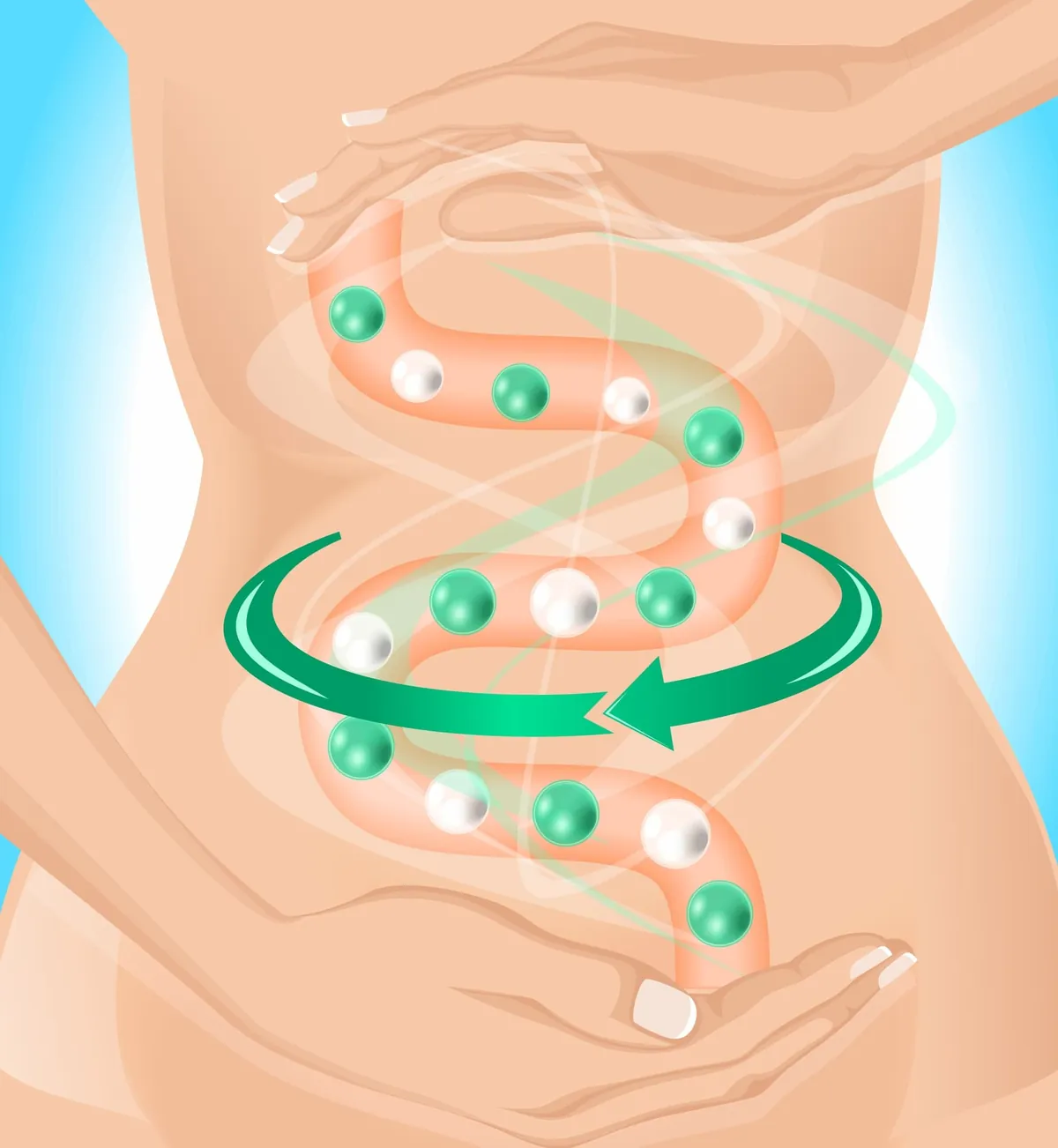
An abdominal self-massage, lying down or sitting: slow circles clockwise with the palm, starting low on the right near the hip bone, up, across, and down the left side. Five to ten minutes, in the evening or before eating.
Stop and see a doctor rather than massage if the pain is acute, or localized low on the right, which can be appendicitis. The same clockwise circuit, done more firmly, is one of our constipation remedies, where it is aimed at moving things along rather than settling them.
Drinkable aloe vera, and the fine print
Take about 2 tablespoons (1 oz / 30 ml) of aloe vera gel intended for oral use, purified and free of aloin, 15 minutes before the two main meals, for no more than 2 weeks. Start small to see how you tolerate it.
This is the item on the page with the longest exclusion list, and it is worth reading in full. Not in pregnancy or breastfeeding, not with irritable bowel syndrome or inflammatory bowel disease, not with kidney problems, and not alongside diuretics, digitalis or oral diabetes medicines. Stop immediately if you get cramps or loose stools.
For context, NCCIH notes that aloe taken by mouth “may be unsafe during pregnancy and while breastfeeding”, that oral aloe latex “can cause abdominal pain, cramps, and diarrhea”, and that leaf extracts have been linked to cases of acute hepatitis. The aloin-free oral gel is not the same product as the latex, and buying the right one is the whole precaution.
If you have IBS, skip this section entirely and read our IBS remedies instead, where the plants are chosen for exactly that.
A word on DGL licorice
Deglycyrrhizinated licorice, sold as chewable tablets, comes up constantly in American health shops for heartburn. Chew before meals, following the packaging.
Why the “deglycyrrhizinated” matters. NCCIH is blunt about ordinary licorice: glycyrrhizin “can cause serious adverse effects, such as irregular heartbeat and cardiac arrest, especially when consumed in large amounts or in the long term”, and even small amounts are risky with high blood pressure, heart conditions or kidney disease. DGL has that compound removed, and NCCIH says oral licorice products without glycyrrhizin “might be safe for up to 4 months”.
And on whether it works, the same page is honest: “there isn’t enough high-quality evidence to clearly support its use for any health condition.” We are including it because you will be offered it, and because knowing which version is which is the useful part.
When to see a doctor
Reflux twice a week or more is not occasional heartburn. MedlinePlus draws that line explicitly: “if you have symptoms two or more times a week or if they cause damage to the lining of your esophagus, you may have gastroesophageal reflux disease (GERD).” That is worth an appointment, because untreated GERD damages the esophagus over years.
Call sooner for: difficulty or pain on swallowing, food that seems to stick, vomiting blood or anything that looks like coffee grounds, black stools, unexplained weight loss, or a hoarse voice and a persistent cough alongside the reflux.
And once more, because it is the one that matters: chest pain with shortness of breath, or pain spreading to the jaw or arm, is a call for emergency help, not an antacid.
FAQ
Heartburn or indigestion, how do I tell?
Heartburn burns and it travels upward, behind the breastbone, often worse lying down or bending over. Indigestion is heaviness, fullness and bloating sitting in the upper belly after eating. Many people get both from the same meal, which is why this page treats them together.
Does baking soda work for reflux long term?
No, and it is not meant to. It neutralizes acid that is already there, so relief is quick and short. Two weeks is the outer limit, and reflux that needs it more than occasionally is reflux that needs a doctor.
Why did French grandmothers drink an infusion after every meal?
Because it was the habit, and because a warm cup of something aromatic at the end of a meal genuinely settles a heavy stomach. The plant mattered less than the ritual of sitting still for ten minutes after eating instead of getting straight up.

Virginie Verglas
Virginie is a French journalist and author. She founded Grands-Mères.net in 2012, and her book "The French Book of Natural Remedies" is the American edition of her work on traditional remedies.